Thursday, March 11, 2010

Erin's Olives: My Cure

Olives plucked directly from the tree are edible, but, unbelievably bitter. "Bitter" is really an understatement, for having tasted them that way, I can tell you that that they are pretty much spit-out bitter. Planted extensively in Southern California for their ornamental beauty and also for commercial purposes, the olive is, unless genetically engineered, a messy tree, spilling a blood-indigo colored carpet beneath its arbor when that season comes. Many years ago, when I lived in Tucson they banned new plantings for just that reason arguing that the trees were an unwanted source of allergens. There are many varieties, and one of the local favorites is the Russian Olive which is a very beautiful gray tree reminiscent of a weeping willow. The fruit of an olive has a gestation that takes it from pip, to firm greenness and shades on to a deep dark fleshy, fluid filled blackness that signals complete ripeness. One can choose to cure the fruit at any point between greenness and ripeness.

The curing of olives is one of the great achievements of mankind. Olive oil, is, and for centuries passed, has been used as a condiment and cooking medium, and probably more importantly as a vital fuel for lamps. Most olive oil comes from the stone, or pip, ground down or pressed. Olive oil has a very strong flavor and can overpower many Northern European or traditional American dishes. I remember being 15 and thinking that I would surprise my parents by making Southern Fried Chicken for dinner. I had watched my mother make the dish repeatedly over the years and learned her method, but, not having developed a real palette, I thought olive oil would be perfect as a medium, and of course it completely overpowered the dish. I was crestfallen for all my efforts even though we all managed to eat it up.

Times change. This last Christmas I was walking up the pathway to Erin Chairez's house in Bakersfield, and I saw that the young Russian olive tree, originally planted as an ornamental, was dripping with plump fruit. I went in, got a large bowl and began picking the the juicy morsels from the tree. I filled the bowl and brought them back down to L.A. You can cure olives with food grade lye and also with salt. Since it was an experiment I thought I'd forgo the cost of the mail order lye, which is also a poison, and try to do it with salt. I scored each deep dark olive with a knife at the branch end and poured water and salt over them to make perhaps a 15% brine. I love long haul food experiments, having learned patience with wine making and meat curing, so, I boned up on various methods from the internet and came to my own process. I poured the whole lot into a gallon ziploc bag and put them in the fridge and after two weeks I pulled them out and changed the dark maroon water with fresh brine and tasted one. Hardly a difference. I repeated this again and again , changing the water less frequently mostly out of apathy, almost thinking that it was never going to happen.

Last week, some three months on, having forgotten about the bag tucked away in a corner of the fridge, I pulled them out and tasted one. It was barely salty but deliciously olive-y. Time to rinse them and dry them. I spread them on a baking sheet at a 225 degree heat and checked them every ten minutes over a half hour period until they had shrivelled ever so slightly and I pulled one out and tried it. The flavor had intensified from that ever so slight dehydration. I resisted the urge to add chopped rosemary or garlic reminding myself that I am something of a flavor purist. I coated them very thinly with olive oil to seal them and unify their color and then canned some and slapped a quick label on the jar(see pic). I must say they are delicious. My only regret is that I did not pick and cure five times the amount. Ah well there is always next year!

Tuesday, March 2, 2010

Letter From New Zealand #2

My friend Peter Huck, journalist and windswept adventurer, recently moved away from Los Angeles with his other half, the lovely Barbara Drake, to beautiful New Zealand. I asked Peter to write a monthly letter from down under as a kind of mirror to my own efforts and experiences here. This is the second letter.

It’s been a dry month in Aotearoa, the Land of the Long White Cloud. Large cracks have appeared in the deep clay cap on our Coromandel block. We’ve spent much of the past month building a bach lean-to – three walls covered with salvaged tin (corrugated iron) and punctuated with louvers, plus a sloping tin roof to catch rainwater, and a floor made from eucalyptus planks – beside our caravan. But, as yet, we haven’t a gutter and a down pipe to catch water.

This precious commodity is in very short supply. Other than rare misty moisty moments – such as a squall that swept across the house site from the Hauraki Gulf last week, momentarily easing the humidity and perking up our plants, but hardly settling the dust – there has been no rain.

This makes washing, drinking and, of course, cooking a challenge. One of our daily tasks is to haul in water, either from the Driving Creek CafĂ© or the creek itself. We also lack power, so each day must swap a trio of ice packs [frozen in a neighbour’s freezer] to cool our Esky or icebox. Given that we’re also working dawn to dusk hours we’ve opted to prepare dishes – home-made dahl, hummus and Provencal-style fish stew, a kiwi bouillabaisse, are standards - in Auckland, tweaking them if necessary in Coromandel. This week’s onion, garlic, tomato and courgette stew base was augmented by gurnard, bought from the fish ‘n’ chip shop a stone’s throw from the Coromandel harbour, and prepared by flashlight as the cicadas buzzed, dusk fell and a glittering canopy of stars joined the moon to cast a magical, theatrical light across the darkening forest.

By LA standards New Zealand droughts are benign. But prolonged dry spells wreck havoc on this nation’s farm economy, not to mention our parched Auckland veggie patch, neglected while we were away. Northland, the area beyond Auckland, is threatening water restrictions. Yet, Central Hawke’s Bay, traditionally prone to long droughts – and best suited to dry country stock farming and grapes – has had a wet summer. There is much talk of El Nino and whether it is influenced by global warming, even as climate change deniers – delighted by the hacked Intergovernmental Panel on Climate Change emails and other scandals, and a vociferous lobby in New Zealand - have had a field day.

Despite its ballyhooed “clean and green” tourist image, enhanced by epic scenery [Ian McCulloch, of Echo & The Bunnymen, once described New Zealand as a “psychedelic Yorkshire,” perhaps due to the extraordinary clarity of the atmosphere; gazing at our 360-degree Coromandel vista is like tumbling into the rabbit hole or stepping into an 18th century landscape by Cook’s artist Sydney Parkinson] and low greenhouse gas emissions, compared to other Organisation for Economic Co-operation and Development nations, New Zealand isn’t nearly as pristine as it makes out. Efforts to turn Auckland into a “super city” by amalgamating local councils are seen by critics as a feint to privatise water, even as the right-wing National government ponders opening up protected land including, maybe, World Heritage status national parks, to mining, an issue that is red hot in the Coromandel Peninsula, site of the nation’s first gold strike at Driving Creek in 1852.

Meanwhile, dairying, a major export, squanders water [pumping from aquifers in Hawke’s Bay for instance to the consternation of non-dairy farmers] and is responsible for copious methane emissions, a greenhouse gas linked to climate change and estimated in 2007 by New Zealand’s National Institute of Water and Atmospheric Research at 35.2% of the country’s output. And a new documentary, based on English journalist Charles Clover’s book The End of the Line, argues that New Zealand has torpedoed its status as a sustainable fishery, due to its destructive, bottom-trawled orange roughy – popular in the US – catch. Waitrose, the UK food chain, has banned orange roughy and hoki, another kiwi fish; a prime example of consumer-driven conservation that New Zealand would be wise to acknowledge. “The number one hole in your system,” Clover told the New Zealand Herald, “[is that] you don’t actually have a proper up-to-date assessment of the 600-odd species you have in your waters.”

I could go on, listing other holes in the “clean and green” PR line. New Zealand has much to be proud of as regards its farming prowess, such as getting food to markets thousands of miles away and surviving without government subsidies. But the colonial legacy in which finite resources, whether fish, timber or water, were commodities to be exploited no longer works. Diminishing resources worldwide have created a new paradigm, in which the world is divided between those who exploit resources for short-term economic gain, and those who see the economy as a subset of the environment, where sustainable use is the only viable long-term option.

©2010 Peter Huck

Thursday, February 4, 2010

Instant Lift

I have been a bit down in the dumps lately. At such times work becomes an uphill struggle and friendships become strained as the stories become stale after the third telling. It is difficult to think anything is worth it, let alone cooking for oneself, especially as the appetite is suppressed and one ceases to eat for all the wrong reasons. I am still a bit worried how quickly one loses weight when one is under real stress.

Today, still dumpy, I noticed half a dozen uncooked shrimp in the freezer, so I threw a saucepan on a burner to bring some shallow water to a boil. I took spinach out of its bag in the fridge, all crisp and fresh, rinsed it, then toweled it dry. 1 minute. I cracked an egg yolk into a metal bowl and whisked a little mustard, sweet white vinegar and sea salt into it until it took up some airy volume adding a dribble of oil and whisked it in and again and again adding more in a burst each time. I was keeping an eye on the water while whisking and when it came to a gentle boil after four minutes I salted the water and dropped in the shrimps and ignored them to finish the mayonnaise which was already taking up more volume. Three more minutes and the mayonnaise was finished and I turned to the shrimp which were nearly cooked. Time to finish the sauce. I was having a craving for Marie Rose Sauce, which perfectly complements spinach and, down right shouts "hello!" to shrimp. I mixed a tablespoon of tomato ketchup with the same amount of horseradish, a pinch of Maldon Sea Salt, a small dash of Tabasco sauce and mixed it together in a little bowl adding after three tablespoons of the fresh mayonnaise until completely combined. I poured cold water into the shrimp saucepan and drained them quickly and left them lukewarm. Shrimp with spinach and Marie Rose sauce made in about 12 minutes. I felt real good for having made a speedy and most enjoyable lunch. This paragraph has taken longer to write than it took me to make and eat the dish even though I slowly savored every bite.

A friend of mine has told me that I've put all my passion into cooking over the last year or so to make myself feel better and I agree I think I have to some degree. You have to eat, you get instant results from the cooking and a sense of complete satisfaction. You also get better at it the more you do it. I just don't understand why everyone doesn't cook every day since it is an amazing salve and a lot less work than you think, especially if you have a dish washer, and, I do not.

Thursday, January 28, 2010

A Letter From Peter Huck in New Zealand

My friend Peter Huck, journalist and windswept adventurer, recently moved away from Los Angeles with his other half, the lovely Barbara Drake, to beautiful New Zealand. They are living in a tiny apartment in Auckland with a very, very small kitchen. Since their excellent and mostly vegetarian dinner parties were such a feature of my social life here, and sadly missed, I asked Peter to think about writing a monthly letter from down under as a kind of mirror to my own efforts and experiences here. This is the first of such entries.

Dateline: Auckland, New Zealand; January 20, 2010

Intrigued that I cook in an even smaller kitchen – a narrow, well-appointed galley betwixt a toilet and a shower; perhaps an eighth of the space in a 19.6 by 11.5 foot apartment, formally a motel room - than the one he graces in Los Feliz, Jonathan has invited me to file an occasional culinary piece from New Zealand, where I returned, after two decades working as a journalist in Los Angeles, to pursue an off-the-grid house project in the Coromandel Peninsula. This post is a tour d’horizon of my new life in Godzone; I’ll get into specifics down the road.

I interpret “culinary” in the widest sense. I am just as interested in learning where food comes from, how it is grown, and the sometimes controversial issues surrounding its production, as I am in cooking and eating. In some respects New Zealand is a huge farm. Agriculture is innovative and entrepreneurial – there are no subsidies – but surprisingly resistant, given the country’s pristine environmental hype, to sustainable, organic methods. Still, for those who look there are plenty of delights.

My life is split between Auckland and Coromandel, a three-hour drive around the rim of a spectacular maritime inlet, the Firth of Thames, then up the Pacific Coast Highway, the Antipodean version, a sometimes one-lane blacktop that twists from sea level to some 1,500 feet, then back again.

I’m now in Auckland, living with my girlfriend Barbara Drake (left, with "pet" Magpie) on the slopes of Mt Albert, one of 49 extinct volcanic “stumps” that litter the narrow isthmus between the Tasman Sea and the Pacific Ocean. It is a maritime city with volatile sub-tropical weather and fertile soil; perfect for fresh sea fish and home grown vegetables - we can hardly keep up with the fecundity of our two tiny plots that keep on giving: silver beet, cabbage, lettuce, rocket [arugula], rhubarb, courgettes, tarragon, thyme, sorrel, nasturtiums, basil, oregano, cilantro and parsley.

Our life is lived in a series of boxes: our city flat, where cooking is a combination of cuisine and choreography; our ‘95 Subaru wagon; two packed-to-the-door storage facilities; and a pair of ancient caravans – one with an almost completed lean-to or sleep-out, largely built from recycled material sourced from community demo yards – on our 27-acre conservation block of regenerating rainforest.

It is a lifestyle – frequent journeys between tiny living spaces – that dictates what we eat. We live on a very cheap budget. Our homegrown veggies are supplemented by organic produce, including fruit, from highway honesty stalls and community gardens in Auckland and Coromandel. Eating well means hooking into food networks, where barter sometimes replaces payment. We also buy fresh fish more or less direct from the boat at various harbours between the city and our land, along with specialist items – cheese, honey, olive oil, wine, condiments or bread – from grassroots producers. We don’t shun supermarkets – rural life hasn’t dented my caffeine habit - but they’re peripheral.

Thus, the Tarakihi depicted in the picture taken in our caravan, as dusk falls on the Hauraki Gulf and a Morepork, or native owl, starts calling on our block, is that day’s catch, bought from the Coromandel fish ‘n’ chip shop. Our meal, cooked by Barbara on a two-ring gas stove in candlelight, included French beans from the weekly farmers’ market, organic chilli sauce from the sleepy community of Papa Aroha, olive oil from one of our neighbours, garlic from another, toasted kelp harvested from New Zealand’s beaches [five times the length of the US West Coast], plus new potatoes and a 2007 “cleanskin” [end-of-vintage wine, sans label] Gisborne merlot from the local store.

Like the US, New Zealand is rediscovering the delights of home grown produce. Gardening networks, including community gardens where some food is free, are emerging. Ironically, for a nation where farm produce is the major export [and sometimes cheaper in Trader Joe’s than it is in an Auckland supermarket], and “clean and green” a national catchphrase [and, as the Guardian pointed out, sometimes a hollow one; more on that at a later date], kiwis rank third on the 2009 OECD obesity list, after the US and Mexico, a consequence of a generation weaned on processed and fast foods. I’ll be exploring these themes, and local cuisine, on future posts.

©2010 Peter Huck

Saturday, January 16, 2010

Cooking from The Books 2

Two Thousand Nine was a banner year in my very personal and loving relationship with cookbooks. It started with the Poleyn and Ruhlman book on Charcuterie, a gift to me Christmas 2008 and I have cured around 5 Bresaolas with salts from Detroit since. Ratio the very good book by Michael Ruhlman followed sometime later in '09, and has been a useful addition to my food library, packaged by Scribner just as tastefully as a volume I have on Confucius by the same publisher. Ruhlman's choux pastry ratio is a great hit on both coasts when I have used it to make chocolate eclairs.

In the spring months of 2009, when new condensed editions of Diana Kennedy's treatises on Mexican Cooking were published, so much changed. Every obscure herb, chile and pork cut mentioned in Kennedy's recipes are readily available in the carnicerias and markets of Los Angeles. Familiar to our neighbors to the south these ingredients helped to realize delicious, fragrant and exotic recipes and bring them to life. Here could assemble foods from a cuisine that was the legacy of at least three grand, and ancient civilizations and do it authentically. Delicious food resulted and my barber, The Best In The West, was amazed that I know what epazote is. I think if you want to cook Mexican food authentically you should keep a copy of From My Mexican Kitchen: Techniques and Ingredients if no other book on the subject.

The largest local national or ethnic entity in my village apart from Latin Guatemalans and Salvadorans, is Armenian. Markets catering to Armenian tastes brim with tahini from Lebanon, locally made Persian style kashk, specially packaged herbs and fruits and Armenian Vodkas and Turkish Rakias. So, I'll admit that stepping out of the Franglo model has stricken me with the middle-eastern food bug. I first bought Claudia Roden's Book of Middle Eastern Cooking in a diminutive paperback many years ago and found it fascinating. The New Book of Middle Eastern Cooking is current and updated and marvelous. Her Jewish Cookbook is exhaustive, and her coffee table beauty, Arabesque, is just a joy. Claudia Roden's book page at Amazon is here. I frequently cook from Roden's books. Therein, perfect, unintentional diet recipes for weight conscious individuals such as myself. Look for recipes that include quinces or eggplant, they are simple to make, but refreshingly complex on the palate.

I have bought many more helpful cookery books this year but in keeping with my trend the favorite cookbook of 2009 is Kamal Al-Faqih’s Classic Lebanese Cooking. Clear, helpful and nicely presented, I expect to use this book much in the future. The Cuisine of Lebanon is probably the most ornate and complex in the middle east and always a joy to taste. Written by a Washington D.C caterer and restaurateur who has moved into my locale, I will be watching out for his pointers and tips for a more fragrant and beautiful 2010. Kate Colquhoun's Taste was also one of the most all round enjoyable reads of 2009 and dispels the American myth of British cooking being primitive.

By the way Santa dropped off The Fat Duck Cookbook for Christmas 2009 and all I can say is WOW, what a read!

Saturday, December 5, 2009

Cooking From The Books 1

I was thumbing through the newly condensed edition of Heston Blumenthal's Fat Duck Cookbook at my local bookstore and was naturally impressed by its sumptuous pictures, no doubt culled and re-dressed from his huge three volume original. What exquisite joy, what superb colors and combinations, what exotic reverie! Then I snapped out of it. Slick and luxurious, this book seemed to have more in common with the fashion industry than cuisine. I might have been flipping through the pages of Vogue rather than a cookbook. Actually, this was more like flipping through Tatler or Vanity Fair.

The cult of chef-auteur often obscures the fact that this is just cooking, dishes offered for gastric consumption. It's all very well being a Blumenthal or Keller, and they are often truly inventive and immersed in deep knowledge, but the back-work and elaborate preparation and assembly of an executed recipe in their kitchens is carried out by a multitude of sous-chefs and assistants in their employ. Like most amateurs I don't employ anyone to cook with me and I doubt if we would fit in this kitchen anyway. It's an extreme challenge for an individual to reproduce one of the more elaborate dishes within these pages, let alone a menu. Blumenthal even has a "lab" where scientist cooks carry out experiments to test his "recipes".

I must admit I have the Fat Duck Cookbook on my Christmas wish
list, but I have not succumbed to Keller's tomes even though his Sous Vide book is very tempting. It may be partly because, if I detect a precious element, I resist. Grant Achatz's Alinea cookbook is the closest book I own from the molecular gastronomy pack, and I confess I get great pleasure from it, despite never having cooked from it. If I ever choose to I do possess local sources for all the ingredients and chemicals cited within Alinea's seductive pages. I find I learn more about the philosophy of using cooking to create something rare and unique from these books, albeit a temporary and singular uniqueness, from these arcane alchemies. But perhaps food has always been about fashion. I would like to emphasize that the recipes in all these books give new meaning to the term "processed food".

Illustrated here: this year's Thanksgiving Turkey with Italian sausage stuffing before and after cooking.


Sunday, September 13, 2009

A Sunday Evening Note

Bresaola is curing, now two weeks into drying.
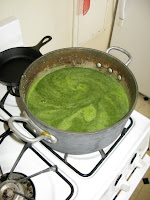
First course tonight - lettuce soup (see pic).
Then pork, brined and roasted, with whole onions and Montmorency cherries and white raisins, steamed french beans to the side.