Saturday, December 5, 2009

Cooking From The Books 1

I was thumbing through the newly condensed edition of Heston Blumenthal's Fat Duck Cookbook at my local bookstore and was naturally impressed by its sumptuous pictures, no doubt culled and re-dressed from his huge three volume original. What exquisite joy, what superb colors and combinations, what exotic reverie! Then I snapped out of it. Slick and luxurious, this book seemed to have more in common with the fashion industry than cuisine. I might have been flipping through the pages of Vogue rather than a cookbook. Actually, this was more like flipping through Tatler or Vanity Fair.

The cult of chef-auteur often obscures the fact that this is just cooking, dishes offered for gastric consumption. It's all very well being a Blumenthal or Keller, and they are often truly inventive and immersed in deep knowledge, but the back-work and elaborate preparation and assembly of an executed recipe in their kitchens is carried out by a multitude of sous-chefs and assistants in their employ. Like most amateurs I don't employ anyone to cook with me and I doubt if we would fit in this kitchen anyway. It's an extreme challenge for an individual to reproduce one of the more elaborate dishes within these pages, let alone a menu. Blumenthal even has a "lab" where scientist cooks carry out experiments to test his "recipes".

I must admit I have the Fat Duck Cookbook on my Christmas wish
list, but I have not succumbed to Keller's tomes even though his Sous Vide book is very tempting. It may be partly because, if I detect a precious element, I resist. Grant Achatz's Alinea cookbook is the closest book I own from the molecular gastronomy pack, and I confess I get great pleasure from it, despite never having cooked from it. If I ever choose to I do possess local sources for all the ingredients and chemicals cited within Alinea's seductive pages. I find I learn more about the philosophy of using cooking to create something rare and unique from these books, albeit a temporary and singular uniqueness, from these arcane alchemies. But perhaps food has always been about fashion. I would like to emphasize that the recipes in all these books give new meaning to the term "processed food".

Illustrated here: this year's Thanksgiving Turkey with Italian sausage stuffing before and after cooking.


Sunday, September 13, 2009

A Sunday Evening Note

Bresaola is curing, now two weeks into drying.
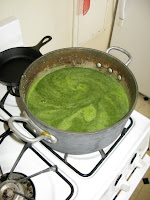
First course tonight - lettuce soup (see pic).
Then pork, brined and roasted, with whole onions and Montmorency cherries and white raisins, steamed french beans to the side.

Monday, August 17, 2009

A Tender Turkey Breast

The Microplane, that ubiquitous favorite of TV chefs and professional cooks across America made it into my cooking drawer a couple of months ago. I usually resist those trends, fearful that their use is all about a cut of the profits for the chef and not the utility of the tool, but I finally gave in and bought one a couple of months ago on sale at the aforementioned Sur La Table. Now I confess that I get an instant thrill every time I use it to zest a lemon or to pulverise a garlic clove so that the natural oils and juices are carried out into the dish in the most conservative and efficient way. I use the zester model, which is a fairly fine grater but there are many many variations and grades to meet your personal needs. Obviously developed from the common or garden woodworking file but with gleaming steel in place of cast iron, I do worry sometimes that I might zest some finger as it is extremely sharp, and I use it with extreme caution in the same careful way I do my mandoline.

I have taken to brining fowl and pork before cooking and it makes a remarkable difference to the tenderness and flavor of the meat, adding garlic and lemon peel to the brine using a microplane. A turkey breast with star anise in a 5% brine with sage and oregano and dry white wine is perfect and imparts a subtle tang to the turkey. What is a brine? We swim in it when submerged in The Pacific, sea salt evenly dissolved in clean cold water.

Thursday, August 13, 2009

On The Table at The Americana

One pleasant, recent addition to regular life in my own locale is The Americana At Brand. Located in The City of Glendale, a handful of miles to the northeast of my neck of the woods but only ten minutes away by car. Glendale is a suburban town with a shine, and I like its quick glint. An island swallowed by the sprawl of LA, it is one of the few civic satellites that has successfully maintained its identity and dignity in recent years, at least to this outsider's eye. The Americana was developed by the same group that gave us The Grove on Third Street, that groovy Farmer's Market extension. The Grove is Beverly Hills adjacent, and a place where many celebrities go when they want a small town mall experience with the glitz they are used to, albeit Disneystyle, but don't want the clinical chic of The Beverly Center. At The Americana they seem to have successfully combined the glitz and gleam with its natural, ready made, suburban location.

The Americana echoes the theme of street and park in Main Street USA, so successfully established by the Disney city states, but with addition of residential accommodation above the shops. Pompeii, but upward (see earlier post). A visit from family who were in town yesterday necessitated a visit and there is a particular corner where Sur La Table, a kitchen hardware chain, and, our own superb, The Coffee Bean and Tea Leaf, Southern California's answer to Starbuck's, face each other on opposite corners of the southernmost Brand Avenue façade.

We stopped in at Sur La Table for a long and leisurely visit and when we were about to leave, cradling our purchases, one of the most helpful and courteous shop managers called me over politely to test my knowledge. I had examined the store maybe three times in the hour that we were there and earmarked various items for future purchase, funds permitting. As I approached him I could see he had one arm raised with hand resting on a huge brass conundrum that I had already figured for an object of importance. It was, without question, expensively made and shone like the sun. Its grandeur announced the gravity of whatever it was that it was built to process.

The Object was probably four feet tall and cast in solid gleaming brass. It had a central screw-press mechanism with a tiny, graceful drain at the bottom of a small three feet round chamber that would hold the item to be pressed. The giveaway for me was that the supporting legs actually fanned out into webbed feet. Duck? Goose? No matter what the feet as long as they be webbed. Too magnificent to press the ordinary flesh of a fowl, I thought, and the answer came quickly. It was a Foie Gras Press! What luxury! And our man confirmed it when I told him I had already thought about it. Correct, he said, without an ounce of disappointment, and added that he had taken me for a food fan. No matter that I had Sonoma Foie Gras on my mind with possible intent to order a lobe or two, against all political correctness. I was delighted and a bit flattered and confirmed that cooking is a great love. I know why I keep coming back to this particular location. The Americana is a good place to visit, better service than any other Sur La Table in Greater Los Angeles and the way it should always be in any store. Plus, you get to ride the trolley round and round for free (see pic above).


Tuesday, July 28, 2009

Nate'n Al, Jon'n Marissa

Nate'n Al is a Beverly Hills institution, on Beverly Drive, and still family owned since its foundation in 1945. It is the best Jewish deli in Southern California. Ragged around the edges and probably last decorated in the early 1970s it is packed and overflowing every lunch time and always has a smattering of celebrities and ancestors of celebrities who order their father's and grandfather's hearties, and their mother's and grandmother's delicacies, from the vast menu. No other deli in town can match or surpass it for delicious, fresh and tasteful excellence, to eat in or take out.

Which is why when my friend Marissa calls and says, "I am in Heavenly Bills and I am going to Nate'n Al, what would you like for lunch?" I get happy and excited! Today she did just that and see the picture for my pastrami sandwich at right with one anxious and unrestrained bite taken before the snapshot, and her Turkey Westwood on my tiny kitchen counter, the result of her care package complete with coleslaw, potato salad and their old and new pickles. Just delicious. Thank you Marissa!

Friday, July 24, 2009

Tiny Kitchens

A superb, jaw-dropping exhibition at LACMA which originated at The National Gallery in D.C. called Pompeii and the Roman Villa: Art and Culture around the Bay of Naples is to die for and prompted my purchase at a local bookstore of Mary Beard's superb book, related only in subject.
My Ancient Greek feeble, and my Latin pathetic, I nevertheless call myself a keen antiquarian and much of my reading originates there. To see these artifacts of the wealthiest inhabitants, and surely, this is not how everyone lived, is wonderful. It is also a reminder of the social diisparities of our own time. In a glossy, clinical museum setting it is sometimes difficult to keep in mind that Roman society was as varied and fragmented as our own, and more likely openly cruelly so. I am personally interested in nuances and customs from our western fore bearers that shine a light on our own era. A sense of history is ultimately important in understanding where we are now.

So, knock me down with a feather, Mary Beard states the fact that even in the biggest villas the kitchens were comparatively tiny. And I mean small at their grandest size . Pompeii and Herculaneum would be the Santa Barbaras and Venturas of their time, and, for sure, many of the largest villas were in the surrounding country (think Ojai and so forth ). Some historians suggest that food was brought in to the tricliniums (small but grand dining rooms) of large houses from the many restaurants in town and also that people may have essentially barbecued in the courtyards of various gardens and waterways for their daily pleasure. This doesn't surprise me at all for the rich in this town at least seem to cater even the smallest events.

However, I feel so much better. If Apicius had to cook in such close quarters I am amazed that he got the results he did but I am sure he never cooked a thing and the documents we have are more to do with his hired cooks' efforts even if he was a real person, perhaps the Homer of antique cuisine? I have a tiny kitchen and I cook some good stuff I think, but, lets face it those Romans of the first century could get a whole lot out of their kitchens too. Hmm that might be a Julie and Julia challenge - though I have read that book and really disliked it. Perhaps Meryl Streep's acting will redeem the story. That is also a story about cooking in a small kitchen that has spawned a bundle of similar efforts using The French Laundry Cookbook or Larousse as yeast.

By the way the roasted organic golden beets marinating in balsamic vinegar and sprinkled with Maldon sea salt in the picture above are sitting pretty next to my curing salts freshly arrived from parts afar. I clarified a half gallon of rich chicken stock today and froze it in packets. It is a real thrill seeing the egg whites take out the dross and leave the gold in the clarification process. If alchemy were ever anything real in the past, it is cooks that own it in our own time.