Tuesday, July 28, 2009

Nate'n Al, Jon'n Marissa

Nate'n Al is a Beverly Hills institution, on Beverly Drive, and still family owned since its foundation in 1945. It is the best Jewish deli in Southern California. Ragged around the edges and probably last decorated in the early 1970s it is packed and overflowing every lunch time and always has a smattering of celebrities and ancestors of celebrities who order their father's and grandfather's hearties, and their mother's and grandmother's delicacies, from the vast menu. No other deli in town can match or surpass it for delicious, fresh and tasteful excellence, to eat in or take out.

Which is why when my friend Marissa calls and says, "I am in Heavenly Bills and I am going to Nate'n Al, what would you like for lunch?" I get happy and excited! Today she did just that and see the picture for my pastrami sandwich at right with one anxious and unrestrained bite taken before the snapshot, and her Turkey Westwood on my tiny kitchen counter, the result of her care package complete with coleslaw, potato salad and their old and new pickles. Just delicious. Thank you Marissa!

Friday, July 24, 2009

Tiny Kitchens

A superb, jaw-dropping exhibition at LACMA which originated at The National Gallery in D.C. called Pompeii and the Roman Villa: Art and Culture around the Bay of Naples is to die for and prompted my purchase at a local bookstore of Mary Beard's superb book, related only in subject.
My Ancient Greek feeble, and my Latin pathetic, I nevertheless call myself a keen antiquarian and much of my reading originates there. To see these artifacts of the wealthiest inhabitants, and surely, this is not how everyone lived, is wonderful. It is also a reminder of the social diisparities of our own time. In a glossy, clinical museum setting it is sometimes difficult to keep in mind that Roman society was as varied and fragmented as our own, and more likely openly cruelly so. I am personally interested in nuances and customs from our western fore bearers that shine a light on our own era. A sense of history is ultimately important in understanding where we are now.

So, knock me down with a feather, Mary Beard states the fact that even in the biggest villas the kitchens were comparatively tiny. And I mean small at their grandest size . Pompeii and Herculaneum would be the Santa Barbaras and Venturas of their time, and, for sure, many of the largest villas were in the surrounding country (think Ojai and so forth ). Some historians suggest that food was brought in to the tricliniums (small but grand dining rooms) of large houses from the many restaurants in town and also that people may have essentially barbecued in the courtyards of various gardens and waterways for their daily pleasure. This doesn't surprise me at all for the rich in this town at least seem to cater even the smallest events.

However, I feel so much better. If Apicius had to cook in such close quarters I am amazed that he got the results he did but I am sure he never cooked a thing and the documents we have are more to do with his hired cooks' efforts even if he was a real person, perhaps the Homer of antique cuisine? I have a tiny kitchen and I cook some good stuff I think, but, lets face it those Romans of the first century could get a whole lot out of their kitchens too. Hmm that might be a Julie and Julia challenge - though I have read that book and really disliked it. Perhaps Meryl Streep's acting will redeem the story. That is also a story about cooking in a small kitchen that has spawned a bundle of similar efforts using The French Laundry Cookbook or Larousse as yeast.

By the way the roasted organic golden beets marinating in balsamic vinegar and sprinkled with Maldon sea salt in the picture above are sitting pretty next to my curing salts freshly arrived from parts afar. I clarified a half gallon of rich chicken stock today and froze it in packets. It is a real thrill seeing the egg whites take out the dross and leave the gold in the clarification process. If alchemy were ever anything real in the past, it is cooks that own it in our own time.

Friday, April 10, 2009

Natural Oils

Tua Fuk Yao in Thai, or yard long beans as I prefer to call them, since the Thai name said in my English, at least, sounds a bit shabby, are in the farmer's markets here at present. They are attractively long and slender and have long been a favorite of mine for their meaty dense texture. They turn a very deep viridian green color after a couple minutes' blanching in a sea-salt brine which brings out their sweetness too. I snip the ends with scissors and usually halve them before preparation. Then, I sauté them in a little sesame oil and throw in some chopped garlic, diced red peppers and fermented black beans, as is the East Asian way. The whole preparation takes a handful of minutes.

I blanched the beans this time, as usual, but did not sauté them. I made a ragout of red peppers, onions and leeks cooked in white wine with tomato puree and snow peas added near the end of its cooking, taking care not to brown any of these ingredients in any extra oil.

The result was a tasty dish somewhere between a soup and a stew with only the oils that the ingredients had brought to the dish. A pleasant vegetarian meal, and one in keeping with my diet.

Sunday, March 15, 2009

Musical Notes

I was given my Bron Mandoline, a year after I moved into this little apartment. An online reviewer describes this glittering amalgam of steel blade encased in more steel as "the Cadillac of the kitchen". Invented by Jean Bron, in Switzerland, about 1950, it does have the strange, dated and outsized looks of another time. A Bron, sitting inanimate on the kitchen counter, just about shouts out that one is not merely prepping a meal but constructing it and I had wanted one for a long time to help me make beautiful dishes. Now there are many imitators and updated incarnations but none slices and cuts quite like this one which positively demands one's attention when finely slicing precision rounds for a Confit Byaldi, or delicate leaves of potato for a pavé or symmetrical slivers for shoestring fries.

One of the great results of The South Beach Diet is that one thinks before one eats, almost every bite. And I do a lot more thinking before I cook. I am also more careful in my food preparation and more inventive too. I have scoured my cookbook collection to concoct new variations of favorite recipes using the allowable and ever increasing ingredient list. I have not yet used any of the many recipes from the book and the weight loss is very real. More than anything I feel healthier and more alert, but it is also a great pleasure to be getting the mandoline out, to prep manually without the use of a food processor and to subsequently dine on dishes with improved texture and that are even more of a pleasure to the eye.

Wednesday, March 11, 2009

A Pound of Flesh

I had my fiftieth birthday in January. Treated to a bash at Woolgrower's Basque Restaurant in Bakersfield with all the usual courses and the owner in attendance, it was a gift from Mr. and Mrs. Diaz and their son Matt. The pickled tongue was as delicious as usual and the fried chicken, one of the main courses, was about as good as the dish can get. At the after party, Sue Diaz, in collusion with my mother who was unable to attend, had baked a birthday cake of the kind I loved as a child and duplicated its flavor almost exactly, which we enjoyed a la mode. Many photographs were taken that day and many of them included me. I'm not one to fret about my looks or the odd ten pound excess from time to time, but I could tell that I was beyond a little overweight. There it was, the visual evidence, and I suspected that the intermittently high blood pressure and general malaise I had been experiencing for a while needed attending to.

Sue Diaz is recently recovered from cancer, and while on chemotherapy, she and her husband dieted to please the doctor using Agatston's popular South Beach Diet. She often had the cookbooks open in the kitchen to a recipe she was making. Browsing through the book the food sounded normal and delicious and I thought that would be the diet to try if I felt the need. About three weeks ago I picked up the book and read it. Concisely written by a cardiologist, I liked the whole premise, that weight loss was a by-product of eating healthily. I also realized that since I could cook it might be possible to make interesting dishes and hone cooking skills. The diet works in three phases the first giving the fastest loss and therefore the most ascetic, the second slowing the speed in Phase One, and the third is maintenance of the target weight. Each phase comes with a list of yes foods and no foods and basically each adds some of those that were absent in the previous phase. Phase One lasts two weeks and disallows all starches, sugars and alcohol and severely limits fruit intake and some high sugar vegetables. In the first two weeks I lost 12 pounds and am now into a third week to get less of a love handle on things before adding a little starch, whole grains, fruit and red wine. I have had no cravings and feel so much better and have recorded a loss of some 15 pounds. My blood pressure is back to normal and my head is clear, no more heartburn or digestive problems, and I suspect my blood sugar average is much better.

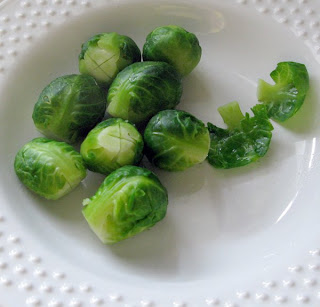
Interestingly enough I have not made a single recipe from The SBD cookbooks, and I will explain why in the upcoming posts but I have stuck rigidly to the allowed foods list and really trying out many of the leafy green vegetables I have neglected over the years such as chard and kale. One of my favorite lunches has been blanched brussels sprouts in a little olive oil and garlic with low sodium, sliced, herbed turkey with it. I am a huge fan of this compact little green ball and it's been a joy to get to know their subtle and complex flavors better.

Wednesday, January 7, 2009

Daube is a Fancy Name for Stew


After the usual Christmas victuals, the quiet, let's-hide-out home life kicks in without general family obligations. So it's a time for comfort food. A favorite cookbook over this season is Paula Wolfert's, The Cooking of Southwest France, a book that you need if you cook and expect cold weather. I made a Daube of Oxtail to Wolfert's recipe. I have to say that this is one of The sublime dishes. It's clarity, depth and sheer richness are unbeatable. A little goes a very long way when paired with fat buttered flat egg noodles and a braised lettuce salad on the side. Unusually, I didn't mess with the recipe much except to substitute veal stock for the pig's foot which I couldn't easily find. You might ask, why? Living in a town full of carnicerias and ethnic markets that you mention frequently, why couldn't you find the ingredients? The answer is simple: Los Angeles is a hard place to navigate quickly even when you know it well due to the distances involved in this vast city and also the abundance of hidden sources that really always need to be personally indexed. So far I haven't been able to devote time to this pursuit. Fun thing is that "stew" is an umbrella name for a multitude of dishes usually thought of as some nondescript wet mass, often with the inaccurate adjective "Irish" attached. This stew, a daube, was one of the greatest I have ever cooked. There was very little extra liquid but that fully flavorful and a knockabout to the meaty bones. Truth is, as I shared the dish with others, in thanks, they put me on track to sainthood as a result!